
K7 Insights
Annual Planning for a Small Business: The Two-Day Version
Part of San Diego Business Coaching
Key takeaways
- Annual planning for a small business takes two days with your leadership team. Day one looks back and puts the hard truths on the wall. Day two turns them into next year's plan and ends with a budget every leader signs.
- Walk out with three or four objectives for the year, first-quarter priorities with one owner and a due date each, a signed budget, a rough scorecard, and every quarterly meeting on the calendar.
- Before anyone walks in, each leader writes a picture of their department at the end of next year, two short lists, five brutal facts, and a draft of their own plan. Whoever keeps the books brings this year's results against plan and a draft of next year's budget.
- Good ideas that miss the cut go in a box the team agrees to ignore until the next planning session. Ideas nobody has permission to ignore are a big part of what pulls a team off its plan.
Annual planning for a small business works best as two days away from the office with your leadership team. Day one looks back at the year you just had and puts every hard truth on the wall. Day two turns those truths into next year’s objectives, first-quarter priorities, and a budget every leader signs before they leave. It takes two days because I just want people to stare at the brutal facts all day before anyone decides what to do about them. I facilitate these as a San Diego business coach, and the whole thing is below: who’s in the room, the pre-work, both days block by block, and the week after.
What is annual planning for a small business?
Annual planning is the meeting where your leadership team agrees on what the company will get done next year, who owns each piece of it, and what it’s allowed to spend. When I work with an owner, we build the five-year picture first. The annual, as I put it on a call once, is “an annual planning session of how do we get that on paper and get all your team to sign off on it.”
Use my annual and quarterly planning template to put the priorities and their owners on paper.
That sign-off is the part a lot of owners skip. Somebody writes a revenue number on the whiteboard, everyone agrees it’s ambitious, and the number never gets tied to a budget or to anyone’s name. A list of goals with no money behind it is a wish list, and your team knows it.
Here’s the two-day split the way I describe it to clients: “The first day is the team building, the reflecting on the year. What did we win, what did we not win? How’s the market changing?” Day two ends with the budget and one question: “does that change any of the conversations from yesterday?”
What should you walk out of annual planning with?
Five things, plus a box.
- Three or four objectives for the year, each one built from a group of brutal facts, each with a finish line you could check in December.
- First-quarter priorities, with one owner and one due date each. EOS calls these Rocks.
- A budget every leader has signed.
- A rough scorecard, meaning the handful of weekly numbers that tell you whether the plan is on track.
- Every quarterly meeting for next year, plus next year’s annual, on everyone’s calendar.
The box holds every good idea that didn’t make the cut (more on that in day two). Before one client’s January session, I told them what done would look like: I wanted us to walk out “having all of our rocks planned, having our budgets, everyone physically sign them, have a rough scorecard, and then all of the quarterly scheduled.” That’s the bar. If you leave with a great conversation and no signatures, you held a retreat.
Who should be in the room for annual planning?
Your leadership team, meaning the people who each own a department and a number, plus whoever keeps your books for the part where you go through the money. For a family-owned HVAC company, that’s the owner, the operations manager, the service manager, the sales lead, and the office manager who runs the books. Five people.
Leave your middle managers out, even the good ones. At some point a leader needs to say that one of their managers isn’t keeping up, and nobody says that with the manager two chairs down. When one leadership team was deciding who’d sit in their planning meetings, I told them they needed a room where they could “speak freely without the fear of any knee jerks or emotions.”
Then keep the roster fixed. One client kept moving people in and out of their planning sessions, and before their annual I pushed back: “whatever we pick, we just need to accept they’re going to be here all of next year. If they’re on the team, they’re on the team.”
The owner doesn’t run it, either. When an owner facilitates their own planning, I compare it to self-implementing a system out of a book: “you’re sitting there reading the instructions and you’re not participating.” Hand the clock and the markers to someone else: a trusted peer, a leader on your team who will cut you off when you run long, or an outside facilitator. And book a room far enough from the office that nobody can pop back to their desk.
Once in a while the phones go in a basket. In early 2024 I wrote: “One thing I started to require in my sessions was no technology during annual planning meetings or quarterlies.” Not everyone liked it, and “I even had one business owner flat out refuse.” The ones who went along with it told me it was the best session they’d had, or something close to it.
What pre-work should your team do before annual planning?
Each leader brings four things, the books bring two, and all of it is due at the leadership meeting before the session, so nobody writes it the morning of.
From every leader:
- A narrative of where their department ends next year. When I send this to a team, the instruction is close to this: “close your eyes. Think about what each department looks like at the end of next year.” Headcount and a couple of numbers help, but the point is to get people thinking forward before they walk in.
- Two short lists: what they’re proud of from this year, and what needs to get done next year.
- Five brutal facts, on a worksheet. The phrase is Jim Collins’s, from chapter 4 of Good to Great, “Confront the Brutal Facts.” In my version they’re the things in your department that frustrate you most, written down plainly. Five each, so day one gets a full wall in half an hour.
- A draft of their own department’s plan. In fall 2025 one CEO and I gave his leaders a full quarter to build theirs, with one rule: “you need to be able to present it to us before so we’re prepared to poke holes in it.”
From the books, whether that’s your bookkeeper, a controller, or an outside accountant: this year’s results against what you planned, and a draft of next year’s budget. I want that draft 80 to 90% done before the session, because building one from scratch in the room burns the whole afternoon. Send the day-one opening questions ahead of time too, so nobody has to invent an answer on the spot.
One more piece, and it’s yours. Before you write your own five brutal facts, take the 30-day test. It’s twelve questions and about three minutes, and it shows which of seven situations still need you when you’re gone for a month. Every situation it flags is a brutal fact about the owner, and it goes on the wall with everyone else’s.
What’s the agenda for day one of annual planning?
Day one looks back, and nothing gets decided. This is the agenda I built for one client’s offsite, minus the parts that only fit them. I planned about six hours, because people were driving in and the stragglers wouldn’t really get started until nine.
Opening questions (under 30 minutes)
Go around the room with a few of the questions you sent ahead. The ones I keep coming back to:
- Who’s the customer you wish you had a hundred more of?
- What was your biggest people or strategy move this year?
- If you had a do-over on this year, what would you do differently?
- What would make these two days great?
The do-over question is my favorite. It gets the honest answers out early.
Brutal facts on the wall (about 30 minutes)
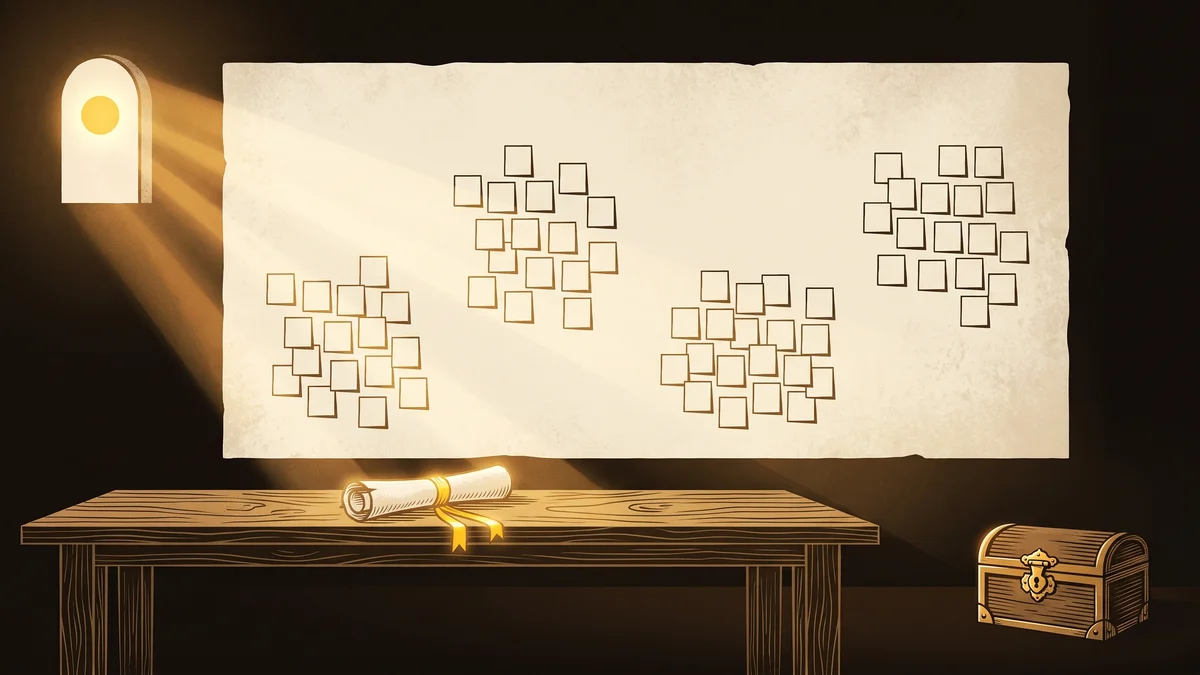
Everyone posts their five. Read each one out loud as it goes up, and leave it there. Nobody discusses them yet. As I told that client while we built the agenda: “I just want people to stare at them all day, is the idea.” Somebody will read a note and think, that one’s about me. Good. They have until tomorrow to get over it.
Grade last year’s plan (about an hour)
Your bookkeeper or controller walks through the year’s close: what you said you’d earn and spend, and what happened. Then count how many of last year’s priorities and to-dos finished late. I use that count as a gut check. If half of them slipped, say so out loud before you write new ones.
Strengths, weaknesses, and trends (after lunch)
This is an easy block to come back to after lunch. I cut the classic SWOT down to strengths, weaknesses, and the trends in your market, because nine times out of ten the threats list and the weaknesses list were the same list. “I was never a huge fan personally of SWOT analysis,” I told another client. “It was hard to bear fruit from it in my opinion.”
Check the long-term target (30 minutes, on a clock)
Does the five-year picture still hold? Did anything this year change where you’re headed or what makes you different? This block can swallow an afternoon, so hold it to 30 minutes. Sometimes I put a countdown clock on the screen. Rewriting the target is a separate project.
Read the narratives aloud
Close day one with each leader reading their department narrative to the room. It’s the first time anyone has heard the others. At that client’s offsite the narratives had been written separately and still came out pretty similar, which told me the team agreed on more than they thought.
Then go to dinner, and leave the wall up.
What’s the agenda for day two of annual planning?
Day two decides, and it ends with signatures and a calendar.
Warm up with four compliments
I open day two with a short warm-up. Pair people up at random, and each tells their partner “what I like about you, what I admire about you, what I respect about you and what I appreciate about you. And no, they cannot be the same thing.” It’s “a way to kind of babystep into the next day” before the hardest work of the two days.
Sort the brutal facts into three or four groups
“Most of today will be categorization,” I told that client’s team on the second morning. Someone who isn’t the owner leads the sorting: combine the notes that say the same thing, then make “three to four groupings that have similar feel.” Their wall became Sales, Ops, Data, and People.
As you sort, you’ll notice that a lot of these are symptoms. Someone said the company had too many project managers. Sorted properly, it was a data problem, because nobody could say how many was the right number. Several of the People notes turned out to be one problem: the right people in the right seats.
Sorting also keeps the year’s priorities from coming out of whatever hurt most recently, the reflex I described in the room that day: “Oh, what happened last week in Q two. Oh, let’s just go fix this or that because it hurt yesterday.”
Turn each group into an objective for the year
Each group becomes one objective, and each objective gets a finish line. “We’re strategically designing the rocks for the year to knock out these four categories,” I told them. For each objective, write the handful of things that would have to be true by December, then ask the question I asked about their data group: “So if we got all four of those things done, would we call the data objective for the year? Finished.” If the room can’t say yes, keep writing.
Set first-quarter priorities
Pick priorities for the first quarter only, each with one owner and a due date. Priorities for the rest of the year get set at each quarterly, when you know more than you do in January. One owner means one name.
Put everything else in the box
By now you’ve got more good ideas than any company can do in a year. The ones that missed the cut go in a box, and the team agrees out loud to leave them there. I told that client this would be the hard part: “as a team, commit that, we’re going to ignore them.” Then I told them what skipping it had cost them that year: “That’s probably a good portion of why we got distracted this year, because it’s those things that we don’t have permission to ignore.”
Walk the budget, then sign it
Put the draft budget on the screen and ask whether the last day and a half changed it. A new objective might need a hire, or a priority might need money moved. Make the changes in the room, then have every leader sign it. What I’m after is every leader “signing off on the budget saying, hey CEO, we can do this.” And I mean a literal signature: “I’d print it out and say, put your signature on.”
Book every meeting for the year
Before anyone leaves, put all four quarterly meetings and next year’s annual on everyone’s calendar. That client had moved every quarterly the year before, so I made the dates a big point: “your quarterly is your quarterly.” Short of a real family emergency, nothing gets scheduled over them. I like Thursdays and Fridays for these, so the Monday and Tuesday fires have already burned out.
The two days at a glance
| Day | Block | What you leave it with |
|---|---|---|
| One | Opening questions (under 30 minutes) | Wins, misses, and do-overs on the table |
| One | Brutal facts on the wall (about 30 minutes) | Five per leader, posted, no discussion |
| One | Grade last year’s plan (about an hour) | Plan against actual, and a count of what finished late |
| One | Strengths, weaknesses, and trends | A short list of each |
| One | Long-term target (30 minutes) | The five-year picture confirmed or flagged |
| One | Narratives read aloud | Everyone’s picture of next year, heard once |
| Two | Four-compliment warm-up | A room that’s talking |
| Two | Sort the brutal facts | Three or four groups |
| Two | Objectives for the year | One per group, each with a finish line |
| Two | First-quarter priorities | One owner and a due date each |
| Two | The box | Every other idea, parked until the next quarterly |
| Two | The budget | Changed in the room and signed |
| Two | The calendar | Four quarterlies and next year’s annual booked |
Somebody has to run that agenda so the owner can sit in it. With the owners I coach, that’s me: I facilitate the annual and the quarterlies, and I can help with the budget. Book 15 minutes and tell me when your year ends.
When should a small business do annual planning?
In January, unless December is genuinely quiet for you. I’m blunt about this one: “I am a huge advocate that you should not be doing annuals in December.”
In December people are on vacation, and the fourth quarter’s priorities aren’t finished, so day one can’t grade them. I have clients who moved their planning to January for exactly that reason. If January is just as busy, move the planning year itself. A few of my clients start their leadership year in February, which gives them January to finish the year’s projects.
I learned this one the slow way. In a company I used to run, December was always busy for us and so was January, and that’s exactly when we kept trying to do annual planning and the budget, with everyone on vacation and customers needing us. Toward the end of my time there I looked at moving our fiscal year to July just to give planning a calm month. In fall 2025 I was still trying to work out how to get the software company I co-founded off a December annual. Do it sooner than I did.
And keep selling while you plan. The fourth quarter is when next year’s first-quarter customers get found. As I told one owner in fall 2025, “we can’t let our foot off the gas just because we’re doing annual plan.”
What happens after annual planning?
The plan moves into your weekly leadership meeting the next week, the budget gets checked every month, and the quarterlies happen on the dates you booked.
Tell the whole company first. When the leadership team at that software company came back from its annual in January 2026, we walked every employee through it at the next all-hands. I told them it “would be disingenuous of us to not do the exact same thing coming out of an annual planning session.”
Then the first-quarter priorities and the scorecard go on the agenda of your weekly leadership meeting. That’s where the plan gets worked, and if yours has gone stale, fix the weekly meeting first.
Once a month, your bookkeeper or controller compares actual results to the budget you signed. If revenue is running at 90% of plan, the spending plan comes down with it, and the hires you budgeted wait until the revenue that pays for them shows up.
Don’t judge the plan on January, though. Reviewing a new budget with one client’s controller, I said it plainly: “I don’t want to hyper focus on January just like we did last year.” Look at the two-month average around the first week of March and decide from there.
At each quarterly, the owner of every priority brings the finished work. The example I give clients: whoever owns the playbooks priority would “come into the quarterly meeting and hand out all the playbooks so we could look at them and go, Cool. Yeah, it definitely is done.” Then you set the next quarter’s priorities, open the box, and close it again.
Put the two days on the calendar this week
Annual planning comes down to one thing: a plan your leadership team built from its own brutal facts and signed with its own names.
So pick the dates this week, before your December fills up. Send the pre-work. Ask your bookkeeper for the year’s numbers and a budget draft. Then write your own five brutal facts, starting with the ones about you. And if you want to sit in the room while someone else holds the clock, I run these for San Diego business owners.
- How long should annual planning take for a small business?
- Two days for most companies with a leadership team. The first day runs about six hours and only looks back: the year's results, last year's plan graded, and everyone's brutal facts on the wall. The second day decides.
- What's the difference between annual planning and strategic planning?
- Strategic planning is the long view: where the company is going over the next several years and how it wins. Annual planning is the next 12 months of that, written down with owners and dollars attached. When I work with an owner, we build the five-year picture first, and the annual is where the first year of it gets put on paper and signed by the team.
- Should we do annual planning in December or January?
- January, unless December is your quiet month. In December people are on vacation, customers need you, and the fourth quarter's priorities aren't finished, so day one can't grade them. If January is just as busy, move your planning year so it starts in February and plan in a month you can actually spare.
- Who should facilitate an annual planning meeting?
- Somebody other than the owner. When the owner runs the agenda, they spend two days watching the clock and managing the room, and the person whose thinking the company needs most stops taking part in the conversation. Use a peer from outside the company, a leader on your team who will hold you to the clock, or an outside facilitator.
- What should an annual plan include?
- Three or four objectives for the year with a finish line you could check in December, first-quarter priorities with one owner and a due date each, a budget the leadership team has signed, a short list of weekly numbers to watch, and the dates of every quarterly meeting.